
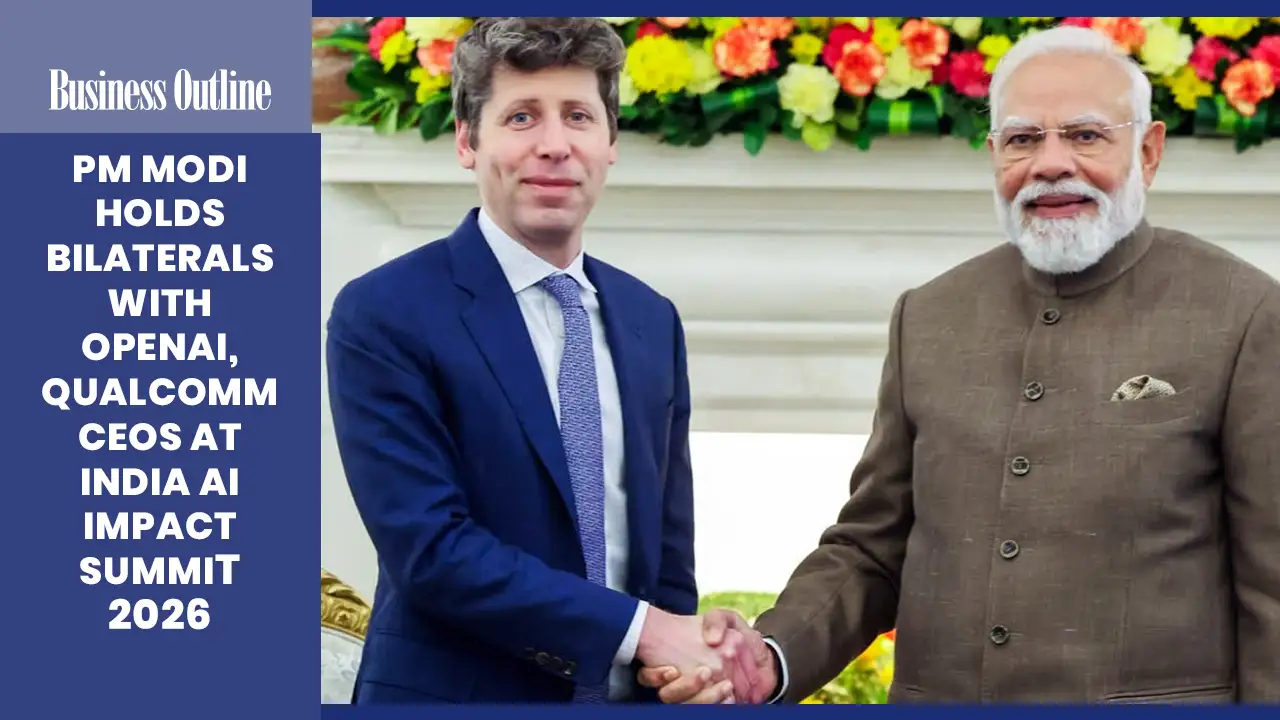
On Friday, PM Narendra Modi met bilateral with Sam Altman and Cristiano Amon, the CEOs of OpenAI and Qualcomm, who attended the AI Impact Summit in New Delhi from February 16 to 21. No formal information about these talks was made public right away.
Altman posted, “Great meeting with PM Narendra Modi today to talk about the incredible energy around AI in India,” on X. With four times as many weekly users in the last two weeks alone, India is our fastest-growing market for Codex worldwide. In response, Modi said, “It was a very good meeting indeed.” India is rapidly advancing in the field of AI. We extend an invitation to the globe to support this industry and invest in our gifted kids.
PM Modi also posted, “It was a pleasure to meet Mr. Cristiano R. Amon, President & CEO, Qualcomm Inc.” We talked about how Qualcomm may collaborate with Indian start-ups and entrepreneurs in AI and other innovaticve areas of technology. We also discussed collaborating closely in the chip manufacturing and semiconductor industries.
Broader interactions during the Summit
Modi’s meeting with heads of state and technological leaders during the Summit were a part of a larger series of interactions. 16 CEOs of deeptech and AI firms participated in a roundtable led by the prime minister on Friday morning. The meeting took place in private.
He subsequently conducted seven consecutive bilateral sessions. These included four meetings with presidents from Mauritius, Slovakia, Sri Lanka, and Liechtenstein. Modi also met United Nations Secretary-General António Guterres.
Altman’s remarks on superintelligence
Altman said, “On our current trajectory, we believe we may be only a couple of years away from early versions of true superintelligence,” during the Summit’s opening ceremony on Thursday.More of the world’s intellectual potential may be housed within data centers by the end of 2028 than outside.
For Altman, a new type of international organization is necessary given the rate of advancement. “For international coordination of AI, and particularly for its capacity to react quickly to developing situations, we anticipate that the world may require something akin to the IAEA,” he stated.
Amon’s keynote on AI and the mobile industry
AI will replace mobile phone operating systems and apps with AI agents, based on Amon’s keynote talk, which he termed as a “fundamental shift in the mobile industry.”
“We expect a fundamental shift in the mobile industry with AI, where the (AI) agent will be at the very center and you can access the agent from your mobile phone, glasses, pendant, or anything that you wear,” he stated. “This is the new future of technology, including the future of mobility, and it will replace a lot of the operating system and the application definitions we see today.”
Qualcomm-Tata collaboration under Make in India
Under the “Make in India” initiative, Qualcomm and Tata Electronics announced a collaboration on Friday to produce Qualcomm Automotive Modules in India at Tata Electronics’ new semiconductor assembly and testing plant in Jagiroad, Assam. In order to satisfy the increasing demand from automakers, the modules, which combine Snapdragon Digital Chassis chips with other parts, are utilized in car systems like digital dashboards, infotainment, and interaction
OpenAI for India initiative
OpenAI announced the start of “OpenAI for India” during the India AI Impact Summit on Wednesday. The initiative’s goals are to increase access to AI nationwide and develop indigenous skills in collaboration with Indian businesses, starting with the Tata Group. The proposal calls for OpenAI to become the first client of TCS’ HyperVault data center business, and for OpenAI and Tata to build AI-ready data center capacity in India.
With time, the Tata Group also intends to introduce ChatGPT Enterprise to all of its workers, beginning with those at TCS. Over 100,000 ChatGPT Edu licenses will be made available to educational institutions through partnerships with OpenAI, which also revealed plans to create more offices in Bengaluru and Mumbai later this year.
FAQs
1. When did PM Narendra Modi meet the CEOs of OpenAI and Qualcomm?
PM Narendra Modi met Sam Altman and Cristiano Amon on Friday during the AI Impact Summit held in New Delhi from February 16 to 21.
2. What was discussed in PM Modi’s meeting with Sam Altman?
The discussion focused on India’s growing AI ecosystem, OpenAI’s expansion in India, and the country’s rapid adoption of AI technologies. Altman highlighted that India is OpenAI’s fastest-growing market for Codex.
3. What did PM Modi and Cristiano Amon talk about?
Their discussion centered on collaboration with Indian startups in AI and emerging technologies, as well as partnerships in semiconductor manufacturing and chip production under the Make in India initiative.
4. What is the “OpenAI for India” initiative?
“OpenAI for India” is an initiative aimed at expanding AI access across India, developing local AI capabilities, building AI-ready data centers in partnership with the Tata Group, and providing ChatGPT Edu licenses to educational institutions.
5. What did Sam Altman say about superintelligence?
Sam Altman stated that early versions of true superintelligence could emerge within a couple of years and emphasized the need for global AI coordination, possibly through an organization similar to the IAEA.
6. What did Cristiano Amon say about AI in the mobile industry?
Cristiano Amon described AI as a “fundamental shift” in the mobile industry, predicting that AI agents will replace traditional operating systems and apps and become central to user experiences across devices.
7. What is the Qualcomm–Tata collaboration about?
Under the Make in India initiative, Qualcomm and Tata Electronics announced plans to manufacture Qualcomm Automotive Modules in India at Tata’s semiconductor assembly and testing plant in Jagiroad, Assam.
8. Which other leaders did PM Modi meet during the Summit?
Apart from tech leaders, PM Modi met presidents from Mauritius, Slovakia, Sri Lanka, and Liechtenstein, as well as United Nations Secretary-General António Guterres.
Read more: