
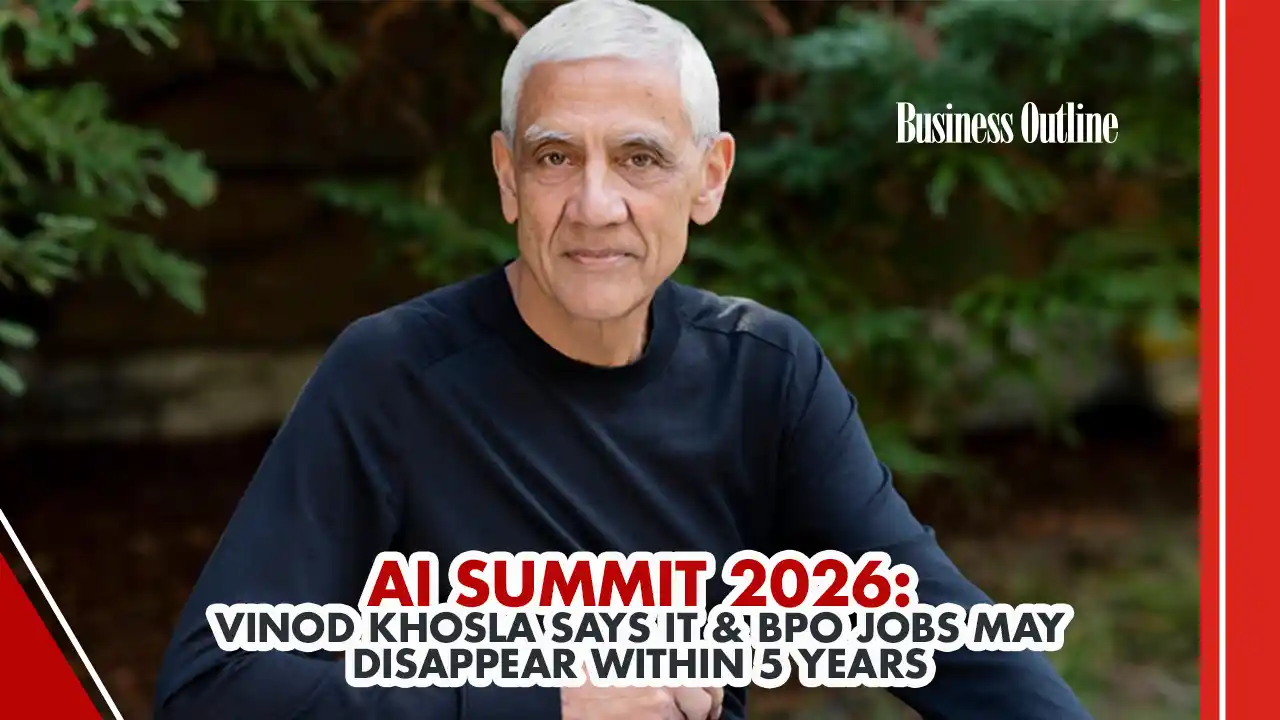
In the words of tech billionaire and venture investor Vinod Khosla, artificial intelligence (AI) capabilities will cause IT services and business process outsourcing (BPO) to “almost completely disappear” in five years. Ahead of the India AI Summit, Khosla told HT that while AI might democrat access to healthcare and education, it will kill off the majority of expertise-based occupations in 15 years.
Khosla supported India’s drive for independent AI while denouncing US President Donald Trump’s immigration policies, even as he acknowledged US-China power.
Founding Sun Microsystems and now managing your own venture capital business are only two of the many experiences you have had in Silicon Valley over the past fifty years. Give us some details about it.
Since I had heard about Andy Grove, a Hungarian immigrant, founding Intel in Silicon Valley, my dream on the day I graduated from IIT was to launch my own business. People are unaware of my first firm, which I founded after finding my way to Silicon Valley. It was also quite successful.
After it went public, I quickly founded Sun Microsystems, and I have spent my whole life supporting and empowering entrepreneurs, helping to build significant businesses and make a positive societal effect. That’s why I’ve been interested in how I got to where I am. It’s always attempting to bring about the outcomes you desire.
In the 1970s, you came to America for the first time. Opposite to what we see now, you must have been one of the very few Indian entrepreneurs in Silicon Valley and the IT industry. How did that feel?
When I started my first business in 1980, the startup atmosphere was very different. It wasn’t a 20 year old starting a company. Establishment individuals were the ones launching businesses as only they could obtain substantial sums of money to do so. So I took a really simple approach. Simply do it. Don’t worry about prejudices, rules, and regulations. I chose to mostly disregard everything else and simply go ahead and build a business, which is exactly what I did.
You’ve been writing for a while now on how AI is impacting the world economy. You have maintained that the revolution in AI is entirely distinct from previous ones. Speak with us about it.
A class of applications, uses, and businesses were made possible by earlier developments like the internet and the smartphone revolution, which were both highly important shifts in platform technology. Thus, the class of businesses like Google and Amazon was made possible by the internet. The class of businesses like Uber, DoorDash, and Airbnb was made possible by the mobile phone. A new class of businesses is being made possible by AI. The intriguing thing about AI is that earlier technology assisted with a variety of tasks.
Human intelligence is being created by AI, and it’s quite probable that over the next five years, AI will surpass most humans in most areas. Very few things will be significantly improved for humans. I’m excluding fields like literature, art, and music, all of which will present opportunities for people. AI will be able to perform economic functions, however. Thus, the US economy as well as the world economy are undergoing an important change. AI has the potential to significantly increase productivity over the next five years, in my opinion.
What will the AI-enabled global economy look like in 10 to 15 years?
The first stage is, in essence, that nearly all expertise will be artificial intelligence. Additionally, AI personnel will be capable of bookkeeping. They will be more adept at accounting than accountants. Medical professionals, doctors, oncologists, mental health therapists, and physical therapists can all be AI workers. AI will replace architects, salespeople, and chip designers. AI professionals will be able to serve as a junior assistant or intern to a human architect or doctor before that time. In the upcoming greater revolution, robotics will be the next wave.
Robots will thus perform the majority of labor, whether it be doing dishes in your kitchen, working on an assembly line, or working on a farm. I predict that it will take them five years to reach maturity. They lag behind in thinking or intellectual activities by around five years. Specifically, what effect does it have on the economy? The impact on jobs will be the largest.
Additionally, it will be considerably simpler and less expensive to complete tasks; for example, robotic labor would cost two or three dollars per hour instead of $20. In my opinion, by 2035, there will be an important worldwide deflationary economy after a decline in inflation.
Doesn’t that suggest that AI will cause the privileged to have an excessive amount of wealth? Mass employment losses also make room for authoritarianism and political backlash, don’t they?
It is apparent that there will be far fewer employment available when someone who is currently 22 or 25 enters their 40s. In addition, no comparable capitalist economy can avoid it. Both positive and terrible news are now available. Every Indian might have access to a doctor for virtually nothing because to AI. AI has the potential to provide nearly free tutoring services to all Indian children and adults.
Every Indian can have access to a lawyer through AI, allowing them to enter the legal system and have their rights upheld. Thus, there are many positive aspects. In a nation like India, AI has the potential to make entertainment almost free. These initiatives are all extremely deflationary.
The government must now redistribute the advantages of this. While redistribution is a bad word, governments will be able to provide a much higher minimum standard of living if there is an endless supply of goods and services, such as healthcare, education, and self-driving cars. In this scenario, jobs will not be available, but these services will essentially be free. I’m excited about the India AI meeting in February because if the Indian government achieves this by 2030, some of these services might be provided for free.
What does AI imply for a nation like India that hopes to generate millions of jobs? If it results in significant employment losses, is its introduction politically viable?
The way AI is used will be greatly influenced by politics and policy. Certain nations will delay that down. Germany is a prime illustration. However, I don’t think stressing job creation is the best way to respond to your question. AI will do things more effectively, thus focusing on schooling to obtain a job might not be the best course of action. There will now be a transitional phase during which I would concentrate on the collaboration between AI and humans.
As opposed to IT services, India may become the world’s leading exporter of AI-based products and services in ten and a half years. Within the next five years, IT and BPO services will most likely cease to exist. As they begin to enter the workforce, India’s 250 million youth should be marketing AI-based goods and services to the rest of the globe. The economic opportunity must move there, in my opinion. Almost no company management or economist is considering it. We cannot ignore it because it poses a serious risk.
Is it possible that China and America will be able to take benefit from AI at the expense of India and the rest of the world?
That is a serious risk, in my opinion, and it would be harmful if the technology was only available in and coming from two nations. There is enough talent in India to create these technologies. Large language models are a major emphasis of the AI model of today. That isn’t the last chapter, in my view. India can get ahead of the curve since other AI models are feasible and will begin to emerge in the coming years. Therefore, the subject of building AI is more difficult, but I do believe India should aim to win that race. The application of AI comes next.
You can create a Flipkart on someone else’s website, for instance. India could definitely put a lot of effort into some of the uses of AI. We have an Indian AI model being built by a firm named Sarvam, which is why I’m so interested in this. Sovereign models are required for a variety of reasons, including national security. To put it simply, everything is up for grabs. In ten years, none of the earlier assumptions will be true.
That has important ramifications. When they modified their last five-year plan four or five years ago, China was clearly ahead of the curve. They set victory in AI as one of the five-year plan’s goals, and they’re working toward it. India ought to adopt a similar perspective.
You are an important political donor, thus this is a political question. Many Indians feel less accepted in America, in part because of stricter laws regarding to students and professionals. Has America evolved?
There are waves in America. You were still a foreigner when I first arrived here in the 1970s and 1980s, and you heard all the tales of prejudice against foreigners and others. However, there was a period of acceptance of immigrants in the 1990s and early 2000s. Indian CEOs, engineers, physicians, and major corporations were so prevalent. However, the American left took the concepts of diversity, equity, and inclusion too far.
They caused a lot of harm, in my opinion. I’m not a Democrat; I’m an independent. I was a Republican once, but I became an independent because I think climate change is a significant enough concern. Neither left nor right politics apply to me.
I typically fall someplace in the middle. The left, in my opinion, has caused a great deal of harm and still does. In New York, Mamdani is a prime example. However, I believe that the criticism that led to Trump’s rise will subside. It won’t last long, in my opinion.
He is the crazy person who will do everything, including lying and cheating. I never thought someone would threaten to conquer Greenland. However, that will also pass. I predict greater shift toward the center and a pushback.
H1B visa limits have also been imposed on the grounds that foreign workers are stealing American employment. What do you think?
This is a pretty simplistic and foolish view of what actually occurs and how innovation and value creation take place. Look, innovation has contributed a significant portion of America’s GDP growth over the past 25 years. According to some estimates, innovation accounts for 40% of total growth. And H1B visas were the engine of the innovation economy.
We used to refer to this movement from India to the US as “brain drain” in the 1970s. That was my fault. People have been returning to India in recent years, which is beneficial for India since it brings skills and knowledge back to the country.
The global economy benefits greatly from this exchange, but Trump has put a halt to it. He is unaware that the goal is to use the innovation economy to create jobs. Therefore, I do believe that Trump’s actions will have long-term negative effects. His immigration is a combination of illegal and legal immigration. The nation does not benefit from illegal immigration. On the other hand, legal immigration is excellent.
Read more: