
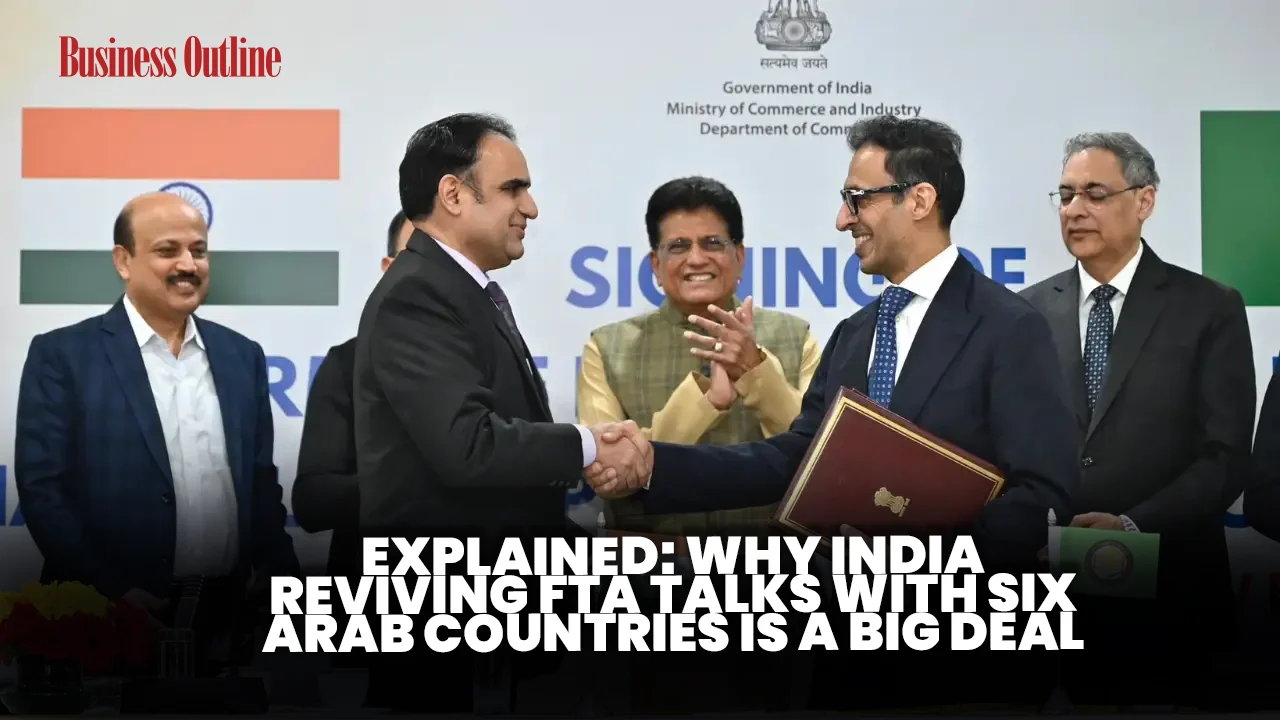
The Gulf Cooperation Council (GCC), a group of six West Asian countries, and India signed terms of reference to officially Start free trade agreement (FTA) discussions. The GCC is an alliance of six Gulf nations: Saudi Arabia, the United Arab Emirates, Qatar, Kuwait, Oman, and Bahrain. Currently, 10 million Indians reside and work in the Gulf Cooperation Council (GCC), adding to the region’s economies.
Since the two previous rounds of discussions between the two regions took place in 2006 and 2008, the start of FTA talks with the GCC would represent a sort of restart of the talks. The third round was canceled because the GCC delayed talks with all nations and economic blocs.
On Thursday in New Delhi, Piyush Goyal, the minister of commerce and industry, oversaw the signing of the ToRs with GCC. The scope and processes of a proposed trade agreement are described in the terms of reference (ToR). According to Goyal, the deal will increase bilateral investment and commerce between the two. “The two trading partners have been trading amongst each other for over 5,000 years,” he informed the press.
Raja Al Marzouqi, the top negotiator for the GCC, stated that the agreement is essential during a period of uncertainty throughout the world. “So it’s a message, it’s a signal for the whole globe, and it’s important for us at this time to try to be more cooperative to avoid any risk that our global economy is facing as a result of uncertainty,” said the president.Goyal said,
“It is most appropriate that we now enter into a much stronger and robust trading arrangement which will enable a greater free flow of goods and services, bring predictability and stability to policy, and help encourage a greater degree of investments.”
According to him, the pact will also support India’s and the GCC countries’ food and energy security. The GCC countries are exporters of gas and oil, whereas India is an important producer of food grains worldwide. “Our trade relationship is already quite strong, at around USD 179 billion. A report by him, the GCC nations can assist us in further broadening our energy sources, and our young, highly trained Indians can supply a lot of goods and services that the GCC countries need.”
The proposed agreement will remove tariffs and non-tariff barriers, which will increase Indian exports. Along with the top-notch businesses operating in the infrastructure sector, we will develop a footing to expand both the Indian and GCC infrastructure. According to Goyal, the partnreship would be extremely beneficial to our petrochemical sector.
He went on to say that the GCC market, which is always growing, will present chances for Indian information and communication technology companies.
In May 2022, India and the UAE signed a free trade agreement. Additionally, on December 18, 2025, in Muscat, India and Oman signed a Comprehensive Economic Partnership Agreement (CEPA). According to Goyal, the government has finalized up to nine trade agreements with 38 developed countries in recent years.
India’s principal negotiator for the agreement is Ajay Bhadoo, Additional Secretary in the Department of Commerce.
Monitoring India’s West Asian Imports and Exports
India’s exports to the GCC increased by over 1% to around USD 57 billion in 2024–2025, compared to USD 56.32 billion in 2023–2024. From USD 105.5 billion in 2023–2024 to USD 121.7 billion in 2024–2025, imports increased by 15.33 percent. From USD 161.82 billion in 2023–2024 to USD 178.7 billion in 2024–2025, bilateral trade has grown.
In the most recent fiscal year, the UAE emerged as India’s third-largest trading partner. India had a trade imbalance of USD 26.76 billion in 2024–2025, with exports to the country totaling USD 36.63 billion and imports reaching USD 63.40 billion in the most recent fiscal year.
In the previous fiscal year, Saudi Arabia ranked as India’s fifth-largest trading partner. In 2024–2025, the kingdom had a trade imbalance of USD 18.36 billion due to USD 11.75 billion in exports and USD 30.12 billion in imports. In addition to exporting pearls, precious and semi-precious stones, metals, imitation jewelry, electrical gear, iron and steel, and chemicals to Gulf countries like Saudi Arabia and Qatar, India mainly purchases natural gas and crude oil from these countries.
In the prior fiscal year, Qatar was India’s 22nd-largest trading partner. In 2024–2025, there was a USD 10.78 billion trade deficit due to USD 1.68 billion in exports and USD 12.46 billion in imports. While exporting goods like wheat, meat, fish, chemicals, and plastics, India mostly imports liquefied natural gas (LNG) from Qatar.
In 2024–2025, Oman ranked as India’s 28th biggest commercial partner. In total, imports totaled USD 6.54 billion and exports totaled USD 4 billion. There was a 2.48 billion trade imbalance. In 2024–2025, Kuwait was rated 29th among India’s trading partners. With USD 1.93 billion in exports and USD 8.28 billion in imports, there was a USD 6.35 billion trade imbalance.
In a similar vein, India sent USD 797.47 million worth of goods to Bahrain, its 65th-largest trading partner, during the previous fiscal year. In 2024–2025, imports totaled USD 843.44 million, leading in a USD 45.97 million trade deficit.
Read more: Top Business Magazine